 033-2231 8646/47
 info@e-cube.in
Power factor correction at low voltage covers most industrial facilities, but plants drawing power at 11 kV or above — steel, cement, textiles, large chemical and process industries — need correction applied at high tension level. HT capacitor banks are a different engineering proposition from their LT counterparts, and specifying them without understanding the differences is a common, expensive mistake.
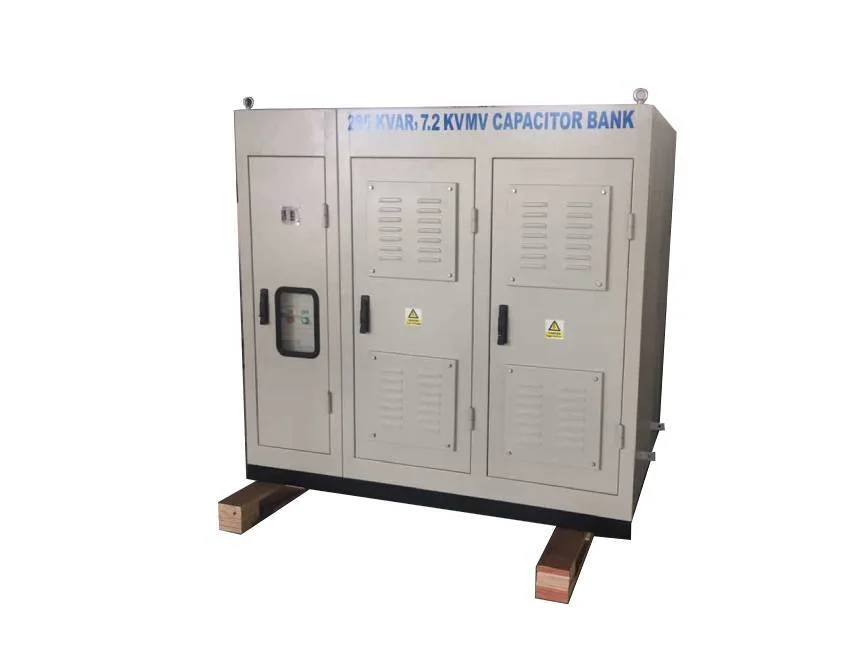
Why HT correction is handled differently
At high voltage, capacitor banks must be designed with much greater attention to insulation coordination, protection discrimination, and fault-current withstand than an LT bank sitting behind an MCCB. A fault on an HT capacitor bank can release far more energy, so internal fusing, discharge resistors, unbalance protection, and proper enclosure design aren’t optional extras — they’re the difference between a bank that trips safely and one that fails catastrophically.
Outdoor rack-mounted vs metal-enclosed
Two common configurations dominate Indian HT installations:
- Outdoor rack-mounted HT capacitor banks — capacitor units mounted on a structural rack, typically installed in the switchyard alongside other outdoor HT equipment. Lower cost per kVAR, but exposed to weather and requiring more site civil work and clearances.
- Metal-enclosed HT capacitor banks — a fully enclosed, weatherproof, IP-rated assembly housing capacitors, protection, and switching in one factory-built unit. Higher upfront cost, but faster installation, smaller footprint, and better protection for sites with space constraints or harsh ambient conditions (coastal, high-dust, high-humidity).
What to specify beyond kVAR rating
- Type-testing credentials — short-circuit withstand, temperature rise and insulation tests should be verified against an accredited lab (CPRI-tested equipment gives a documented, third-party-verified basis rather than a manufacturer’s self-declaration).
- Detuned reactors — if the site has any harmonic-generating loads (increasingly likely with VFDs and modern drives), the bank should be specified with series reactors tuned below the lowest significant harmonic order to avoid resonance, not as a bare capacitor bank.
- Discharge and protection — internal discharge resistors bringing residual voltage down to a safe level within the specified time, plus unbalance and overcurrent protection appropriate to the bank’s configuration (single or double star).
- Switching mechanism — fixed banks for stable base reactive demand, with staged/automatic switching for facilities where reactive demand varies meaningfully through the day.
Sizing against real demand
HT capacitor banks are a significant capital item, and correctly sizing kVAR against the facility’s actual reactive demand profile — not just the transformer’s nameplate rating — avoids both an undersized bank that fails to hit the PF target and an oversized one that risks leading power factor and overvoltage during light-load periods.
Related reading: see our HT Metal Enclosed Capacitor Banks and Outdoor HT Capacitor Banks.