 033-2231 8646/47
 info@e-cube.in
Once a facility decides to correct its power factor with capacitor banks, the next question is almost always the same: APFC or RTPFC? Both automatically switch capacitor steps in and out to track load, but they solve for different problems — and picking the wrong one either wastes money or leaves the plant exposed to the exact penalty it was meant to avoid.
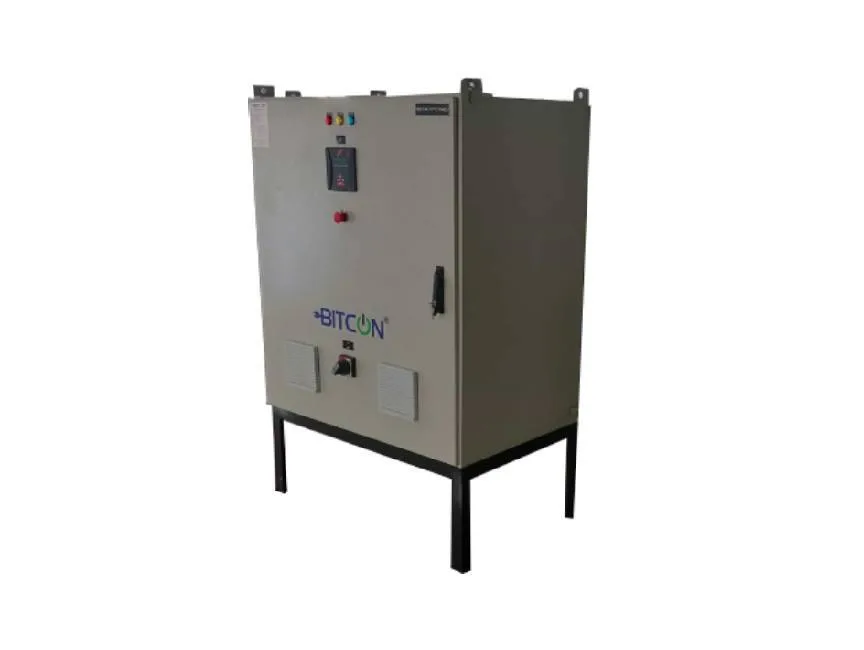
APFC: the standard for steady, cyclical loads
An Automatic Power Factor Correction (APFC) panel uses contactor-switched capacitor steps, controlled by a microprocessor-based relay that monitors PF and switches capacitor stages in discrete blocks (commonly in ratios like 1:1:2:2 or 1:2:4). Switching typically happens within a few seconds of a load change. For facilities with motors, compressors and general machine loads that change gradually — shift starts, machine cycling, seasonal variation — APFC is the workhorse: reliable, well-understood, and considerably lower cost than thyristor-switched alternatives.
The limitation is switching speed and contactor wear. Contactors have a finite mechanical switching life, and frequent rapid load swings will shorten it. APFC also can’t respond fast enough to correct PF within a single AC cycle.
RTPFC: for loads that change in milliseconds
Real Time Power Factor Correction (RTPFC) panels use thyristor switches instead of contactors, correcting PF within a single half-cycle (around 10 milliseconds). There’s no mechanical wear, no switching transients, and no risk of capacitor step chatter. This matters enormously for loads with rapid, repetitive fluctuation — welding lines, presses, cranes, rolling mills, arc furnaces — where a contactor-based APFC panel would be constantly switching, wearing out fast, and still lagging the load.
Side-by-side
- Switching speed: APFC — a few seconds; RTPFC — under one AC cycle.
- Switching element: APFC — contactors (mechanical wear); RTPFC — thyristors (no wear, no arcing).
- Best fit: APFC for steady industrial and commercial loads; RTPFC for fast-cycling, high-frequency-switching loads.
- Cost: APFC is materially lower cost per kVAR; RTPFC’s premium is justified specifically by duty cycle, not by PF target alone.
Getting the choice wrong
The most common mistake is specifying APFC purely on a facility’s average PF from the electricity bill, without checking how fast the load actually swings. A press shop with 0.85 average PF but load spikes every few seconds will grind through APFC contactors within a year or two and never quite hit its correction target between switching events — the panel is always one step behind. Conversely, RTPFC on a genuinely steady load is an unnecessary expense.
How to decide
A short load-logging exercise with a power analyzer, capturing kVAR demand at sub-second resolution during actual production, answers the question definitively: if the load swings materially inside a few seconds, RTPFC; if it moves gradually over minutes or shifts, APFC.
Related reading: see the full specification range for our BITMatic APFC Panels and BITStatic RTPFC Panels.