 033-2231 8646/47
 info@e-cube.in
Diesel generators are supposed to be the safety net — the equipment that keeps production running when grid power fails. But a DG set switched in without proper synchronization can do more damage than the outage it was meant to solve: out-of-phase closure onto a live bus is one of the most destructive events an electrical system can experience.
What synchronization actually means
Before a generator can be connected to a bus that’s already energized — whether that’s the grid, another running generator, or a bus about to be transferred back to grid supply — its voltage, frequency, and phase angle must match the bus within tight tolerances. Close the breaker outside those tolerances and you get a violent inrush current, mechanical shock to the generator shaft and coupling, and potential damage to switchgear, transformers and the load itself.
Where synchronization is unavoidable, not optional
- Multiple DG sets running in parallel — common in facilities sized beyond a single generator’s capacity, or wanting redundancy. Every set added to a running bus must synchronize to it.
- DG-to-grid parallel operation — facilities that run generation alongside grid supply (for peak shaving, captive power export, or a “no-break” transfer strategy) must synchronize the DG to grid parameters before closing in.
- Load transfer back to grid after an outage — even a simple open-transition changeover benefits from synchronized closure timing to avoid a hard break in supply to sensitive loads.
Manual vs automatic synchronization
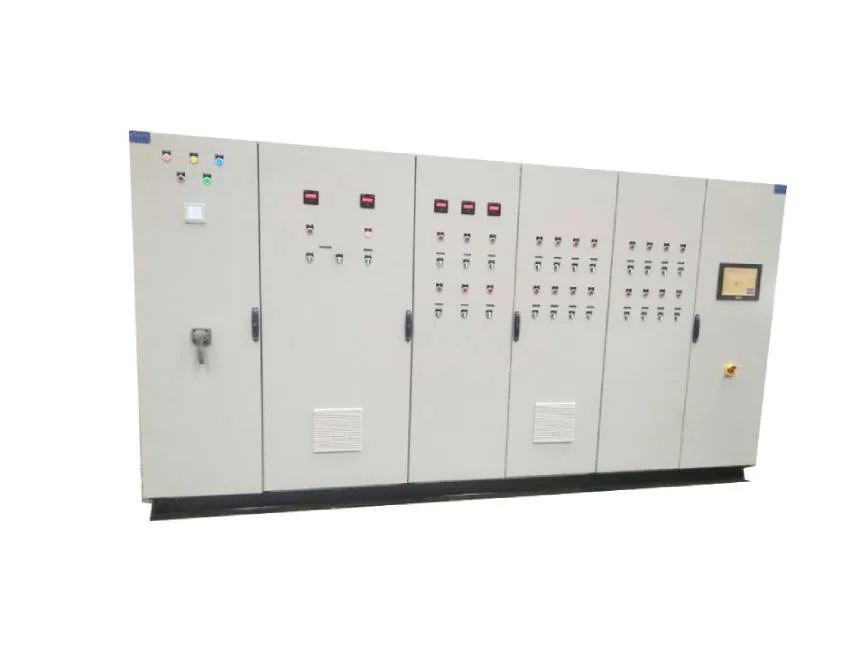
Manual synchronization — an operator watching synchroscope lamps or a meter and closing the breaker by judgment — is slow, operator-skill-dependent, and carries real risk of a mistimed closure under pressure (exactly the conditions of an actual outage). An Automatic Mains Failure (AMF) and synchronization panel removes that risk: it continuously monitors both sources, automatically adjusts the incoming generator’s governor and AVR to match voltage, frequency and phase, and closes the breaker only within a programmed synchronization window — typically within a few degrees of phase angle and a tight frequency band.
What a good DG synchronization panel provides
- Automatic voltage and frequency matching via governor/AVR control signals, not just monitoring.
- Check-synchronizing relays as an independent protection layer, preventing closure even if the primary logic fails to catch an out-of-tolerance condition.
- Load-sharing control for parallel-running sets, so multiple generators share load proportionally rather than one set carrying a disproportionate share.
- Sequenced changeover logic for grid-DG transfer, minimizing break time for critical loads.
The cost of getting this wrong
An out-of-sync closure isn’t a near-miss that resolves itself — it’s a fault-level event capable of damaging the generator’s stator and coupling, tripping upstream protection, and in severe cases requiring a full generator rewind. The cost of a properly engineered AMF/synchronization panel is small next to the cost of a single bad closure, quite apart from the production loss during the resulting downtime.
Related reading: see our DG Synchronization Panels for automatic, fail-safe generator paralleling and grid transfer.