 033-2231 8646/47
 info@e-cube.in
Every industrial electricity bill in India carries two numbers that matter far more than most plant managers realize: the kVA (apparent power) drawn from the grid, and the kW (real power) actually converted into useful work — running motors, lighting, welding sets, compressors. The ratio between the two is your power factor, and a poor one quietly costs facilities lakhs of rupees a year in penalties and wasted capacity.
What power factor actually measures
Power factor (PF) is simply kW ÷ kVA, expressed as a number between 0 and 1 (or a percentage). A PF of 1.0 means every unit of power drawn from the grid is doing useful work. In practice, inductive loads — induction motors, transformers, welding equipment, VFDs — consume reactive power (kVAR) in addition to real power, which drags the ratio down. A typical unmanaged industrial load sits anywhere between 0.65 and 0.85 PF.
Why utilities penalize low PF
State electricity boards size their transformers, cables and switchgear for kVA, not kW. A facility running at 0.7 PF forces the utility to supply roughly 43% more current than one running at 0.98 PF for the same useful output — more line losses, more transformer loading, more infrastructure strain. That’s why most Indian tariff structures apply a PF penalty (often a surcharge that kicks in below 0.90–0.95 PF) and, conversely, a rebate for maintaining a high PF.
The three costs of ignoring it
- Direct tariff penalty — typically 1–2% additional charge for every 1% PF falls below the utility’s threshold.
- Lost transformer and cable capacity — reactive current occupies capacity that could otherwise serve additional load, forcing premature capex on larger transformers or feeders.
- Higher line losses (I²R) — since losses scale with the square of current, even a modest PF improvement can meaningfully cut distribution losses inside the plant.
How it gets fixed
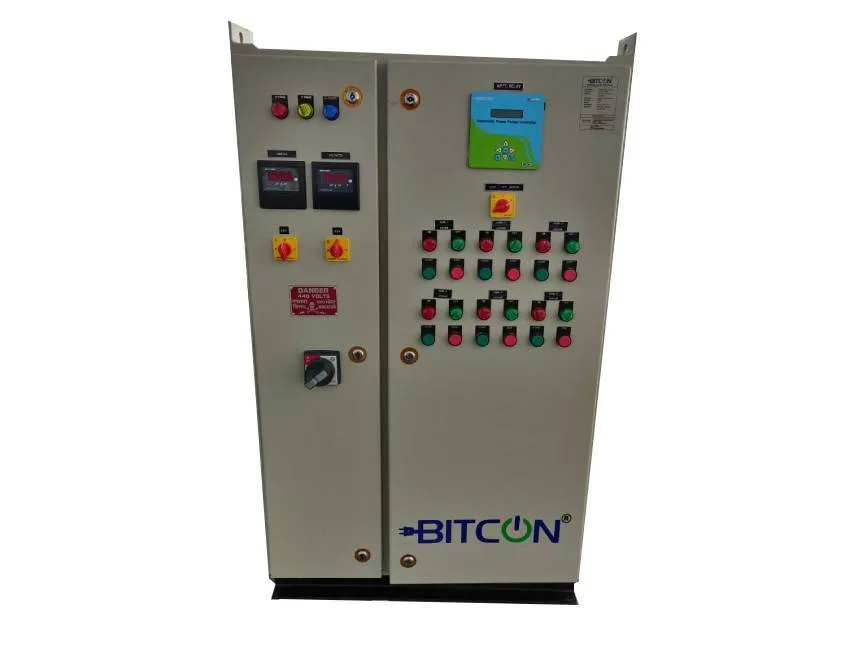
The standard correction is to install capacitor banks at the load center or main incomer, which supply the reactive (kVAR) component locally instead of drawing it from the grid. A well-sized capacitor bank, sized against actual kVAR demand measured over a representative load cycle, typically brings PF up to 0.95–0.99. Facilities with fluctuating or intermittent loads — presses, cranes, compressors cycling on and off — need automatic switching rather than a fixed bank, so correction tracks the load in real time instead of over- or under-compensating.
Where to start
Before sizing any equipment, the first step is an actual measurement: an energy meter or power analyzer logging kW, kVAR and kVA over at least a full production cycle, including startup surges and idle periods. Sizing off the electricity bill’s average PF alone tends to under-correct peak-load conditions, which is exactly when penalties bite hardest.
Related reading: for a deeper look at sizing and selecting between fixed and automatically-switched correction, see our power factor correction overview, or get your plant’s exact reactive-power profile measured with a power quality audit.